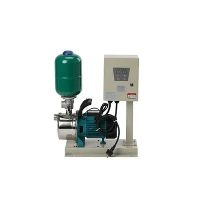
As a supplier of household water pump controllers, I often encounter a common query from customers: "Is a household water pump controller compatible with all water pumps?" This question is crucial as it touches the heart of ensuring the efficient and safe operation of water supply systems in homes. In this blog, I'll delve into the factors that determine compatibility, explore the different types of water pumps and controllers, and provide insights to help you make an informed decision.
Understanding Water Pumps
Before discussing compatibility, it's essential to understand the different types of water pumps commonly used in households. The two main categories are centrifugal pumps and positive displacement pumps.
Centrifugal pumps are the most widely used in residential settings. They work by using an impeller to create a centrifugal force that moves water through the pump. These pumps are known for their high flow rates and are suitable for applications such as water supply from wells, boosting water pressure in multi - story buildings, and irrigation systems.
Positive displacement pumps, on the other hand, operate by trapping a fixed amount of water and then forcing it into the discharge pipe. They are typically used for applications that require a constant flow rate, regardless of the pressure, such as in dosing systems or small - scale industrial processes.
Types of Household Water Pump Controllers
There are several types of household water pump controllers available in the market.
- Pressure - based controllers: These controllers monitor the water pressure in the system. When the pressure drops below a set value, the controller turns on the pump to increase the pressure. Once the desired pressure is reached, the pump is turned off. A popular example is the 110V Water Pump Electronic Pressure Switch, which is designed to work with a range of 110V pumps and provides precise pressure control.
- Flow - based controllers: Flow - based controllers measure the volume of water flowing through the system. They turn the pump on when the water flow starts and off when the flow stops. This type of controller is useful for applications where the water demand varies frequently.
- Smart controllers: With the advancement of technology, smart controllers have become increasingly popular. These controllers can be connected to a home network or a mobile device, allowing users to monitor and control the pump remotely. The Household Water Pump Controller is an excellent example of a smart controller that offers features such as adjustable pressure settings, leak detection, and energy - saving modes.
Factors Affecting Compatibility
The compatibility between a water pump and a controller depends on several factors:
- Voltage and Power Requirements: Water pumps and controllers are designed to operate within specific voltage and power ranges. It is crucial to ensure that the controller can supply the necessary power to the pump without overloading or under - powering it. For example, a 110V pump requires a controller that can handle 110V electrical supply.
- Pressure and Flow Ranges: Different pumps have different pressure and flow rate capabilities. The controller must be able to accurately measure and control the pressure and flow within the pump's operating range. If the controller's pressure or flow settings are not compatible with the pump, it may lead to inefficient operation, pump damage, or even system failure.
- Pump Type: As mentioned earlier, centrifugal and positive displacement pumps have different operating characteristics. Some controllers are specifically designed for one type of pump and may not work effectively with the other. For instance, a controller designed for a centrifugal pump may not be able to provide the precise control required for a positive displacement pump.
- Pipe Size and System Configuration: The size of the pipes in the water supply system and the overall system configuration can also affect compatibility. A controller that is suitable for a small - diameter pipe system may not work well in a large - diameter system, as the pressure and flow dynamics are different. The G1.25 Water Pump Controller is designed to be compatible with specific pipe sizes and configurations, ensuring optimal performance.
Compatibility Testing and Verification
To ensure compatibility between a water pump and a controller, it is recommended to perform compatibility testing. This can be done by the manufacturer or a professional installer. During testing, the pump and controller are connected to a test system, and the performance is monitored under different operating conditions.
If you are unsure about the compatibility of a particular pump and controller, it is advisable to consult the manufacturer's specifications. Most manufacturers provide detailed information about the compatibility of their products, including the types of pumps they can be used with, voltage requirements, and pressure and flow ranges.
Case Studies
Let's look at some real - life examples to illustrate the importance of compatibility.


Case 1: A homeowner installed a pressure - based controller on a centrifugal pump without checking the voltage requirements. The controller was designed for a 220V system, while the pump was a 110V pump. As a result, the pump overheated and failed after a few months of operation. This could have been avoided by ensuring the correct voltage compatibility.
Case 2: A small business owner installed a flow - based controller on a positive displacement pump. However, the controller was not calibrated correctly for the pump's flow rate. This led to erratic pump operation, with the pump turning on and off frequently. After consulting the manufacturer and reinstalling a compatible controller, the problem was resolved.
Conclusion
In conclusion, a household water pump controller is not compatible with all water pumps. Compatibility depends on several factors, including voltage and power requirements, pressure and flow ranges, pump type, and system configuration. It is essential to carefully consider these factors when selecting a controller for your water pump.
As a supplier of Household Water Pump Controller, we are committed to providing high - quality products and professional advice to ensure that our customers get the right controller for their pumps. If you have any questions about compatibility or need help selecting the right controller, please feel free to contact us for procurement and further discussion.
References
- "Water Pump Handbook" by Igor J. Karassik et al.
- Manufacturer's specifications of various water pumps and controllers.