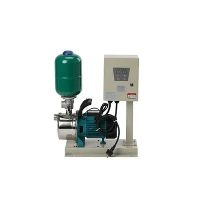
As a supplier of water pump inverters, I've witnessed firsthand the growing interest in energy - efficient solutions in the water pumping industry. In this blog, I'll delve into the question: How much energy can a water pump inverter save?
Understanding Water Pump Inverters
Before we discuss energy savings, let's understand what a water pump inverter is. A water pump inverter, also known as a variable frequency drive (VFD), is a device that controls the speed of an electric motor driving a water pump. By adjusting the frequency and voltage supplied to the motor, it can vary the pump's speed according to the actual demand for water.
This is in contrast to traditional water pumps that typically run at a fixed speed. When the demand for water is low, a fixed - speed pump still consumes a significant amount of energy, while an inverter - controlled pump can slow down and use less power.
Factors Affecting Energy Savings
- Load Variation:
The most significant factor influencing energy savings is the variation in the water demand. In many applications, such as domestic water supply, industrial processes, and irrigation, the water demand fluctuates throughout the day. For example, in a household, the water usage is much higher during morning and evening hours when people are taking showers, doing laundry, and washing dishes. At other times, the demand drops significantly.
A water pump inverter can adjust the pump speed to match the actual demand. When the demand is low, the pump runs at a lower speed, consuming less energy. According to industry studies, if the water demand varies by more than 30% over a day, a water pump inverter can lead to substantial energy savings. - Pump Efficiency Curve:
Each water pump has an efficiency curve that shows how its efficiency changes with different flow rates and heads. A pump operates most efficiently at its design point. However, in real - world applications, pumps often operate at off - design conditions. A water pump inverter can adjust the pump speed to keep it closer to its peak efficiency point.
For instance, if a pump is oversized for a particular application, it will operate at a lower efficiency when running at full speed. By using an inverter to reduce the pump speed, the pump can operate at a more efficient part of its curve, resulting in energy savings. - System Head and Friction Losses:
The system head, which includes the static head (the vertical distance the water needs to be pumped) and the friction losses in the pipes, also affects energy consumption. As the pump speed decreases, the friction losses in the pipes decrease significantly because the flow velocity is reduced. This means that less energy is required to overcome these losses.
Calculating Energy Savings
To estimate the energy savings of a water pump inverter, we can use the affinity laws. These laws describe the relationship between the pump speed, flow rate, head, and power consumption.
The affinity laws state that:
- The flow rate (Q) is proportional to the pump speed (N): (Q_1/Q_2 = N_1/N_2)
- The head (H) is proportional to the square of the pump speed: (H_1/H_2=(N_1/N_2)^2)
- The power consumption (P) is proportional to the cube of the pump speed: (P_1/P_2=(N_1/N_2)^3)
Let's assume a pump is initially running at full speed ((N_1)) and consuming power (P_1). If the pump speed is reduced to (N_2 = 0.8N_1) (i.e., 80% of the original speed), the new power consumption (P_2) can be calculated as follows:
(P_2=P_1\times(0.8)^3 = 0.512P_1)
This means that by reducing the pump speed to 80% of its original speed, the power consumption is reduced to about 51.2% of the original power.
In real - world applications, the actual energy savings may be slightly lower due to inverter losses and other factors. However, in many cases, energy savings of 20% - 60% can be achieved by using a water pump inverter.


Our Product Range and Energy Savings
At our company, we offer a wide range of water pump inverters, each designed to provide maximum energy savings in different applications.
- Wall - mounted LCD Screen Inverter: This inverter features a wall - mounted design with an LCD screen for easy operation and monitoring. It is suitable for small - to - medium - sized domestic and commercial water pumping systems. The advanced control algorithms in this inverter allow it to quickly adjust the pump speed to match the water demand, resulting in significant energy savings.
- Variable Frequency Pump Converter for Home Use: Specifically designed for home water supply systems, this inverter is easy to install and operate. It can detect the water pressure in the system and adjust the pump speed accordingly. By ensuring that the pump only runs when needed and at the appropriate speed, it can reduce the energy consumption of a home water pump by up to 50%.
- New Three - phase Water Pump Inverter: Ideal for industrial and large - scale commercial applications, this three - phase inverter can handle high - power pumps. It offers precise control over the pump speed, allowing for efficient operation even in complex industrial processes. The inverter's intelligent control system can optimize the pump operation based on real - time data, leading to substantial energy savings.
Case Studies
- Domestic Water Supply:
A residential building with a traditional fixed - speed water pump was consuming a large amount of electricity. After installing our Variable Frequency Pump Converter for Home Use, the pump was able to adjust its speed according to the water demand. As a result, the energy consumption of the water pump was reduced by 45%. The homeowners noticed a significant decrease in their electricity bills, and the water pressure in the building remained stable. - Irrigation System:
An agricultural farm was using a large water pump for irrigation. The water demand varied depending on the time of day and the crop requirements. By installing our New Three - phase Water Pump Inverter, the pump speed was adjusted to match the actual water demand. The energy savings were estimated to be around 35%, and the farm also saw an improvement in the irrigation efficiency.
Conclusion
In conclusion, a water pump inverter can save a significant amount of energy, especially in applications where the water demand fluctuates. The energy savings depend on factors such as load variation, pump efficiency curve, and system head. By using advanced control algorithms and intelligent systems, modern water pump inverters can optimize the pump operation to achieve maximum energy efficiency.
If you are interested in reducing your energy costs and improving the efficiency of your water pumping system, we invite you to contact us for more information about our water pump inverters. Our team of experts can help you select the right inverter for your specific application and provide you with a detailed energy savings analysis. Let's work together to create a more energy - efficient future.
References
- ASHRAE Handbook - HVAC Systems and Equipment. American Society of Heating, Refrigerating and Air - Conditioning Engineers.
- Pump Handbook, 4th Edition. Igor J. Karassik et al.